Rhode Island Red: Sourced Egg and Weight Facts
Compare sourced Rhode Island Red records for 200–280 and 238 eggs per year, brown shell color, mature weights, maturity, comb, and class.
Egg production estimates by source
Each egg is 20 eggs/year. Solid = published minimum; outline = rest of the range. Scale goes to 320.
Mature weights by source
Quick facts
| Attribute | Value | Source |
|---|---|---|
| Eggs Per Year | 200–280 eggs/year |
|
| 238 eggs/year |
| |
| Egg Color | brown |
|
| Hen Weight Lb | 6.5 lb |
|
| Rooster Weight Lb | 8.5 lb |
|
| Maturity Weeks | 19 weeks |
|
| Comb Type | single |
|
| Apa Class | American |
|
| Temperament | active |
|
| Breed Type | heritage |
|
| Climate Tolerance | all areas |
|
Overview
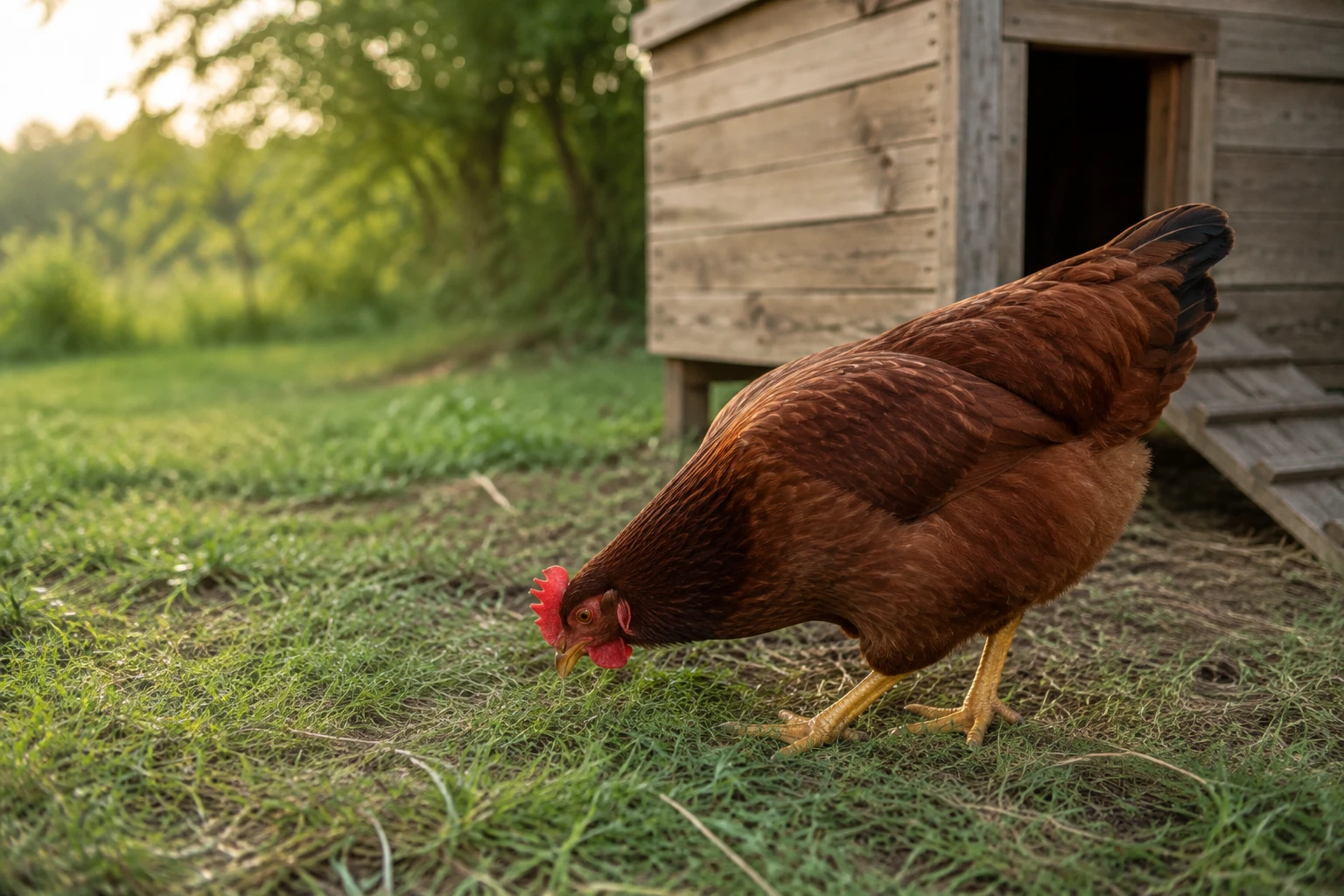
This Rhode Island Red profile retains source-scoped records from Cackle Hatchery and McMurray Hatchery. It includes two annual egg figures, matching mature weights from both sellers, and supported categorical fields. It does not use the generated editorial image as breed evidence.
Egg records
Cackle lists brown shell color and an estimated range of 200–280 eggs per year. McMurray lists an average of 238 eggs per year and explains that its average is based on breeder-flock data. The single McMurray value falls within Cackle's wider range, so both can remain visible without creating a numerical contradiction.
The JSON stores the Cackle range as numeric lower and upper bounds and the McMurray figure as a single numeric value. Both carry the same eggs-per-year unit. The chart can calculate a range midpoint for layout while continuing to display the source values as 200–280 and 238.
These are catalog records, not promises for an individual bird. The evidence does not establish a weekly output, a lifetime total, or a production advantage over any other published breed. No such extrapolation appears in this profile.
Weight and maturity records
Cackle lists a hen at 6.5 pounds and a rooster at 8.5 pounds. McMurray's table separately lists a female mature weight of 6.5 pounds and a male mature weight of 8.5 pounds. The sources use different sex labels but give the same two values.
McMurray's structured field lists 19 weeks to maturity. This page uses that explicit table value rather than retaining the earlier draft's unsupported derived figure.
The retained weights and maturity value are not used to infer size class, growth rate, feed, space, or care requirements. They remain discrete catalog fields with their original source links.
Other sourced fields
Cackle says it offers the single-comb variety as its main production type. It also identifies the breed's show class as American, labels temperament as active, and describes Rhode Island Reds as a recognized heritage breed. Those statements support the displayed categorical values at seller scope.
McMurray describes its Rhode Island Reds as hardy birds and a choice for all areas across the United States. This page records the shorter all-areas catalog value but does not turn that description into climate-specific instructions or a guarantee.
Earlier claims about development dates, official status, popularity, friendliness, comparative output, dual-purpose use, housing, feed, space, or medical topics are omitted. The remaining content explains only the retained evidence and how each field is represented.
Related published pages
Flock size calculator
Enter your household size and target egg output. The calculator returns the flock size and space you'll need based on the productivity tier you pick.
Hens needed: 2
(4 × 2 eggs/week / 5 eggs/hen/week, rounded up)
Coop space: 4 sq ft (2 sq ft/hen × 2 hens)
Run space: 20 sq ft (10 sq ft/hen × 2 hens)
These are minimums. Most backyard keepers give 1.5–2× this much space, especially for run area, to allow range rotation and reduce feather-picking behavior.
Where these numbers come from
- Low tier 3 eggs/hen/week — Egg Production: 150 – 280 eggs per year www.cacklehatchery.com
- Medium tier 5 eggs/hen/week — Egg Production: 200-280 eggs per year www.cacklehatchery.com
- High tier 6 eggs/hen/week — Cackle lists White Leghorns as producing large to extra-large white eggs, with an estimated 280–320 eggs per year. www.cacklehatchery.com
- Coop 2 sq ft + run 10 sq ft per large chicken (minimum) — A small bantam chicken needs a minimum of 1 square foot of indoor space and 4 square feet of outdoor space, while a large chicken needs a minimum of 2 square feet of indoor space and 10 square feet of outdoor space. extension.msstate.edu
Frequently asked questions
What annual egg figures are retained?
Cackle Hatchery lists 200–280 eggs per year, while McMurray Hatchery lists an average of 238.
What mature weights do both retained sources list?
Both records list hens at 6.5 pounds and males or roosters at 8.5 pounds.
Which maturity value is published?
McMurray Hatchery's structured record lists 19 weeks to maturity.